Monday, 29 February 2016

The Great Gatsby: Women and Liberty

Lynne Franks (businesswoman and social commentator)


The theme "women and liberty" is clearly present throughout the novel The Great Gatsby and when comparing ideas on women's liberty within the book to what that means today shows a clear contrast and change throughout the two periods in history. The video that I have linked shows Lynne Franks discussing the role of women in the 21st century and how the world is changing and shifting to becoming more understanding and cooperative of the "feminine way". During the time of the Great Gatsby, characters such as Myrtle and Daisy represent very different ideas on women's liberty during the 1920s. Myrtle is a very interesting character in the novel as she represents the awakening of pre-marital sex and adultery. During the 20s, sex was plastered throughout the media, in films and magazine etc. Women would be dressed up in revealing clothing and some would have multiple love affairs with men, for example the character of Myrtle fits this description. Myrtle does not act like a traditional "lady" as the early 1900s description of a woman who is respectable and formally dressed. Could I go as far to say that Myrtle acts in a very masculine way due to her infidelity and harsh words and behaviour? Franks might say that Myrtle was showing signs of competing with men by having an affair with Tom and wanting to find her own liberty through him.

Daisy is also a very interesting character within the novel. Franks discusses how men in the 21st century are sharing parenting duties with their wives or partners and are getting involved in parenting far more than any other generation of men have. When comparing this behaviour to that of the behaviour in Great Gatsby, there is a clear contrast. Daisy is mainly in charge of her and Tom's daughters upbringing and does not ask Tom to perform any of the parenting duties herself or the child's nanny does. Men did not play a huge role in their child's lives during this period in history, it was considered the woman's job to bring up the child well. This begs the question as to whether or not women during this time had any liberty whatsoever. Of course they began to dress and act differently. there were more opportunities for women such as Jordan who was a professional golfer, but were any of them actually respected in society and by men? Were any of them respected by their fellow women? Franks makes a point in the video about how women should strengthen other women and that this is happening in the 21st century. By helping each other, women can accomplish many things. Myrtle and Daisy, in the book, show no signs of coming together and realising they were being fooled and hurt by the same man and there is no sign of a real friendship between Daisy and Jordan. Although women achieved forms of liberty during the 20s, such as the 19th amendment and the social freedom, many were still heavily oppressed due to society's ideals of what a woman should be and how women were treated by both men and women.

Tuesday, 23 February 2016

The Searchers - Opening Scene

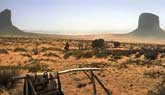
I have chosen the opening scene of ‘The Searchers’ where John Wayne’s character Ethan Edwards rides into the setting and is welcomed to the sight of his brother and sister in law. Both his brother Aaron Edwards and Martha Edwards do not appear pleased to see Ethan even though this is the first time they have seen him in several years. Ethan is a civil war veteran and you’d expect the family to be filled with joy when they see him on the horizon, instead there is a very strange look on both of their faces, almost a threatened look. This could represent how Ethan could threaten the family dynamic by his presence, the wilderness and the family do not mix in a positive way.
The opening scene is classic of
westerns where the main character, the majority of the time a male, enters the frame from the distance. This allows the audience to see the iconic landscape of the west, such as the high mountains, the barren land and the scorching sun behind the ‘cowboy’ figure. In this scene Ethan is portrayed to be a mysterious figure approaching some sort of civilisation, this is common in all westerns such as Shane. Also Ethan is by himself with nothing else but his horse and the wilderness surrounding him, this represents a solitary life which highlights the culture of the west during this time period. It’s a traditional way that the main characters enters the story, alone and from the wilderness.
I think this scene is a good representation of the west as it shows both the family dynamic and also the wilderness. It also shows the different aspects of male characters as it shows Aaron Edwards alongside his wife which portrays a family man and also Ethan Edwards who is the stereotypical tough, lone male who has no sense of belonging.


The Searchers- Edwards homestead burnt down

Edwards homestead burnt down

The Searchers is an iconic Western movie and contains many ideological Western traits. It therefore, includes many incredible scenes which demonstrate the myths of the American West.
This being said, I have chosen an earlier scene in the movie in which the protagonist Ethan Edwards (John Wayne), returns to the Edwards house to find it burnt to the ground by the Comanche tribe. This scene marks the beginning of the story, as it not only indicates that Debbie (Lana Wood) and her older sister Lucy (Pippa Scott) had been abducted, but also demonstrates the long hatred between the settlers and the Natives. 


From this scene director John Ford makes it evident that there is a conflict between the Natives and the white settlers. By doing this, he has created the stereotypical roles of villain and hero. This formulated device has been used throughout history and The Searchers is no exception. Being a traditional Western movie, Ford depicts the Natives (or more specific Scar and the Comanche tribe) as the villainous savages that tortured and killed the innocent white settlers, also abducting the two girls. This in turn leads to Ethan gaining the role of the stereotypical hero, who will go to any extent to find his nieces and save them from the brutal Natives. This role can be linked to the ‘major theme’ of ‘a quest’ which is associated with the ‘Western hero myth’. By imposing these roles Ford has created a classic Western trait in which the Natives are the evil which needs to be destroyed and the white settlers, as the victims. Due to Ethan’s loss of his murdered family and kidnapped nieces, his feelings towards the Natives are justified, so when he goes on a quest not only to find his niece but to also avenge is family, the audience are left to support his actions. Through this use of stereotyping Natives as evil, Ford could be representing how the white people felt about the Natives in general and how they despised them.

In addition to this, Ford implements the ‘American Eve Myth’, in which a female character provides ‘motivation for male action’. This is apparent in this scene, when Ethan sees the house on fire, he starts to yell for Martha (Dorothy Jordan), demonstrating his inner feelings towards her. When seeing her blue dress on the floor it is evident to Ethan and the audience that Martha was rapes by the Indians. The emotion implications given when Ethan drops his head low after seeing the bodies of his massacred family, show the power and effect that the event has caused. From the stable manly figure at the start of the film, Ethan takes on a more manic state which can be associated with his loss of Martha more than the other family members. This loss drives his anger and obsession for vengeance and to find his nieces. Ethan follows the stereotypical role of a hero who is pushed to the limits and must save his family.
Overall in this particular scene I believe that the myths of the American West are reinforced, due to the cruelty of the Comanche tribe and the quest in which Ethan has to go on, to not only save his nieces but also to hurt the people who killed his family. In addition to this, many typical cinematic themes have been used which are used to uphold these Western myths.

The Searchers- ending scene

After viewing the film 'The Searchers', a scene that stuck out to me was the ending, where Ethan is seen not entering the "family home" and then leaving as the door to the home closes. The song is also very suggestive as it sings "ride away, ride away, ride away". The perfect ending to a western movie, the main character saves the girl and brings her home.

What I find most interesting about this scene is how it leaves its interpretation up to the audience. It is not known for sure if Ethan rides away to somewhere different or allows some time for the girl to be welcomed home. But I think the way in which most people interpret the ending, is that Ethan feels he does not belong in the family home. Throughout the film, he causes problems for the typical family life, separating the potential lovers (Martin and Laurie), having a connection with his brothers wife Martha, and seeming to cause disruption and stress whenever he arrived in a situation.

By the end of the film, he has realised he does not belong in this family and must move on as not to cause more suffering and trouble. I thought that this scene reinforced some myths of the American West. Constant motion played a big part in the development of the west and men like Ethan, unsettled and looking for a home, helped the progression of the west and potentially drew more people into this fast and exciting lifestyle. It also shows how difficult and lonely this lifestyle could be. Many made the decision to travel westward alone, they may have had no family or wanted to make money to settle and find family out in the west. Ethan represents the difficulties of life in the west through his loneliness and constant need for movement, as shown through the ending of the film. But he also shows the freedom many could possess through living this difficult but exciting life.


Searchers - Meeting Scar

Upon viewing the searchers, one key scene stuck in my mind more than the rest; the meeting between Scar and Ethan.

This scene to me is very important as it is the two contesting parties. One thing I had noticed was how the director John Ford makes the audience dislike Scar, even though he had only been briefly seen in the movie early on. Throughout the movie the name 'Scar' often brought terror with people Ethan had met, even the United States Army are looking for him. This makes the audience want to hate Scar. Giving him the stance that he is an aggressive individual who kills for fun. Before the scene where he meets Ethan I had envisioned him being ruthless and violent towards anyone, however I was very disappointed to see he was not as the stories in the movie made him seen. He doesn't do anything overly aggressive individually, more he depends on his men to do it for him. It was a bit of an anticlimax between him and Ethan, who is visibly more aggressive and violent than Scar and just exudes more rugged masculinity and looks more impressive than Scar.

The character of Scar is one that features prominently in many stories, but what is more synonymous is the actual scar on his head. A scar means violence, it means he is bad. It means he has done something in the past that has a story. Scars are something that the audience is drawn towards immediately. In examples today, scars are used to define major roles in movies, which are mainly bad i.e. Scar in the Lion King, or perhaps even in different genres, Anakin Skywalker in Star Wars. Perhaps this whole idea that a scar defines a character started with Searchers. It's a striking image. The comparison between Scar in Searchers and Scar in the Lion King is an interesting one. The type of character both of the Scar's are, are both very similar. The type of character Scar was in Searchers is the type of character that has grown to be re-used in movies today. Perhaps Scar was based off an actual Indian from this time, but the actual character has been exaggerated to make the audience further dislike the Indians in this story. Movies like these that have a detrimental effect outside of the screen. Wanting the audience to dislike Indians in a movie would often lead to a similar effect outside of the screen.


Monday, 22 February 2016

The Searchers

I have chosen the scene where the group of searchers come across a Comanche burial ground with a dead Comanche, killed by what is presumed to be a raid by another group of white settlers.

I have chosen this scenee because I believe it represents how white men and women felt about the natives. This scene, in my opinion, accurately represents the racism and hatred of the natives felt by white settlers. It is clear to the audience that this group in particular have a hatred for Native Americans as the group show no respect to this dead Comanche. This is made evident when Ethan shoots out his eyes. There was obviously no need for him to do this as the Comanche was clearly not being a threat to the group.  In this scene, Ethan in particular is portrayed as being racist and vindictive. You could argue that he has a right to feel this way as he believes this tribe abducted his nieces, however, I think this represents how many white felt, even if they had no apparent reason for feeling this way.

Racism is clearly shown in this scene when Nesby says "I Don't like it", the term "it" in this phrase indicates racism as it is implying that white settlers did not see Natives as human beings with emotion or feelings, but as objects to discard. Ethan's vindictive side is also shown as by shooting out the Comanche's eyes, he has condemned him as now he is forced to be in 'limbo' as he cannot enter the "spirit land".

 I think that this scene is a god representation of the west and the feelings of white settlers towards Natives as the racism and hatred shown by this group is likely to have been a shared feeling among many white settlers at the time.

Wednesday, 17 February 2016

Apache Tribe

http://mescaleroapachetribe.com/
Apache Indians today are found in Oklahoma, Arizona and New Mexico. The website I have chosen gives a detailed insight into the culture and history of the Apache tribes and the different aspects of their lives today and in history. It gives information on the religious life of the individuals and the rituals involved.    
The Apache were a group of culturally related tribes in the South Western area of America in states such a New Mexico, Eastern Arizona, Southern Colorado and West Texas. The Apache tribes appear to be incredibly courageous and cunning, defending their territory to the very end. The name ‘Apache’ means ‘enemy’, the people of the tribe were extremely aggressive towards the invading settlers. Apache men acquired simple weapons but they were ferocious hunters, they hunted buffalo on the Great Plains as well as deer in the mountains. As with most Native American tribes their religious belief was centred on the surrounding nature and also the supernatural.
Apache tribes were at war with US troops and also Mexican troops. At first the war was between Mexican soldiers and the tribes but in 1846 the US went to war with Mexico. At first the Apache tribes promised American troops a safe passage through the mountains and the harsh landscape as they saw America as an ally that would rid the Mexicans off their land. Mangas Coloradas who was the principal chief and war leader signed a peace treaty with America after the US claimed land from Mexico. As a result there was an influx of gold miners in the Santa Rita Mountains. During the 1850s there were growing tensions between these miners and the Apache tribes. The peace treaty was abandoned and the tribes were involved in another conflict with superior forces.


Among the Sierra Nevada Mountains

The oil painting I have chosen is called ‘Among the Sierra Nevada Mountains’ and was painted by Albert Bierstadt in 1868. The image portrays diverse landscape ranging from mountain tops to a crystal clear lake.
This painting has a variety of colours, the darker colours are to the right and to the left of the image with an intense bright white in the centre above the mountains. I believe that the white light symbolises hope of a better life for the travelling pioneers across the American frontier. The fact that it’s in the middle of the painting may represent that this hope is the main goal that they ae striving towards. The mountains are in front of the beaming sun, this may be as a barrier quite literally in the form as a physical object. However they may represent the hardships of the journey west overall, to reach the light and rich land which was waiting for them, pioneers had to face different obstacles.

There is also an abundance of wildlife in this image, this may show the untouched, untamed wilderness that Western America has to offer. The deer seem to be a family as there are young fawns included. They are looking towards the light as if they were travelling towards it, this could be representing travellers making their way westwards. To the right of the image there is a forest and in contrast to the rest of the image it seems very dark, this shows the difference between the East and West in terms of hope and opportunity during this period. There are also trees that have fallen as well as stumps, which doesn't portray a positive image where as to the left everything is pristine ad almost angelic. The waterfall in the centre of the painting is weaving through the valley between the mountains and disappears beneath the light, it almost seems like a trail and highlights the fact there are always ways around these different obstacles.

Mary Elizabeth Munkers Narrative – Crossing the Great Plains in 1846

The narrative starts with Mrs Munkers describing the amount of families that came together to move westwards. She says that there are fifty families that are ready to make this journey including her family which consists of her dad, ‘his invalid wife…three married sons…one married daughter…five younger children’. Mary was ten years old when this event happened, it seems like a big family and already you can imagine the difficulties that lay ahead of them. Not only because of the harsh landscape but also the fact that there is a large number of them and the mother isn’t able independent due to her unfortunate situation.
Mary and the rest of the party were one of the first pioneers to travel across this path and she says that there were no bridges across the streams, if there wasn’t suitable timbre to build rafts the family had to use their beds as floats. This shows how difficult the journey westwards was, especially for the first emigrants. Another hazard that Mary faced as well as other parties was the weather, Mary was in the middle of a storm and although no one was hurt in this situation storms and other natural hazards were serious problems that the pioneers faced.

Eventually the family settled in Mill Creek which was four miles East of Salem. The father wanted to secure this piece of land as there were a good amount of resources nearby which was appropriate due to the mother condition. The four brothers became miners which allowed the family to become wealthy. Mary acknowledges that her journey west wasn’t the most difficult in comparison to others, she recalls hearing stories of Indians attacking whole parties, diseases such as cholera affecting individuals and also livestock dying leaving families stranded on the plains. The journey west was full of potential danger not only from human factors but also other factors ranging from storms to disease.  

Tuesday, 16 February 2016

The Shoshone-Bannock Tribes

The Shoshone-Bannock Tribes website provides a substantial amount of information on many different features of their lives, from their history, to their government. They website also offers historical photos of tribe members.

Located in Idaho, the Fort Hall Indian Reservation is home to the Shoshone-Bannock Tribes, which consists of ‘the eastern and western bands of the Northern Shoshone and the Bannock’, previously known as ‘Paiute’. During the 1600’s, the Northern Paiutes ‘began to travel with the Shoshone tribe in pursuit of buffalo’ and became the Bannocks tribe.

In 1863 and 1868, both the Shoshones and Bannocks agreed to a peace treaty, known today as the ‘Fort Bridger Treaty’. This treaty was created due the strain between the tribes and settlers. Numerous Shoshones were killed by the settlers, this attack was ‘one of the first and largest massacres of Native peoples west of the Mississippi River.’ Thus the peace treaty was created.

The Shoshone-Bannock Tribe have developed through the ages, under the 1934 Indian Reorganisation Act, ‘they operate under a constitution approved on April 30, 1936.’ Through the establishment of the tribal government, they have become more independent and self-sufficient, as they have built up an economy and created a variety of tribal enterprises.
The Shoshone-Bannock Tribes of the Fort Hall Reservation 


Cherokee Tribe

http://www.cherokee.org/

The website I have chosen is an organisation that was founded by Cherokee Indians. A federally recognised organisation who claim to be the 'largest tribal nation in the United States'. The Cherokee's mission is as follows; "The Cherokee Nation is committed to protecting our inherent sovereignty, preserving and promoting Cherokee culture, language and values, and improving the quality of life for the next seven generations of Cherokee citizens." 

The Cherokee Tribe, one of the largest in American history were originally located throughout the American Deep South. Most notably in Oklahoma, however parts of the Cherokee 'nation' were found as far away as North Carolina. Progressively pushed back by those taking their land, the Cherokee's found themselves finally settling in Oklahoma, the same place that still practices the Cherokee rituals today. From reading the 1828 census, I have deduced that there were 13,518 Cherokee Indians spread out in different districts. The census also mentions how many non Cherokee were married to Indians. Something I find rather extraordinary given the year. If it were later in the century it would be more plausible.

The Cherokee Indians were more advanced in terms of their social standing than other tribes. An example of them being more socially advanced is when you look at the names of some of them. Many of the Cherokee's were earning English names. An example is William Penn, not the William Penn but nonetheless a very English name. The others are still holding Indian names: His Shield (Yanktonai), Levi Big Eagle (Yanktonai), Bear Ghost (Yanktonai) and Black Moustache (Sisseton). This image was taken in 1909.

Today, the Cherokee Nation are responsible for keeping the traditions and culture of the tribe. They have over 300,000 members which is a massive amount for the number of actual Cherokee Indians there were. The group today consists not only of descendants but also of those who are married into Cherokee families. As well as many other tribes across the US who want to keep traditional values alive in the 21st century.


The Hopi Tribe


http://www.hopi-nsn.gov

The Hopi tribe are located primarily in northeastern Arizona and according to the 2010 census there was an estimate of 18,327 Hopi's in America. They were once referred to as pueblo people in the 16thc when they first encountered the Spanish and this is because they lived in villages, "pueblos" in Spanish. 

The name 'Hopi' is a shortened version of their name " Hopituh Shi-nu" meaning"peaceful people". The term Hopi also stems from their religion, spirituality and ethics. They have always viewed land as being sacred with agriculture being a key part of their culture. The Hopi and the Navajo have experienced much land disputes as from the 1940's to the 1970's the Navajo tribe were moving further on to the Hopi land, it got to the point where the Hopi's then took the issue to the US government who then established "district 6" which clearly divided Hopi land from Navajo land. Land disputes then calmed down but you can imagine that the Navajo tribe were not very happy.

The website of the Hopi tribe is nothing to be desired, it is very simple and does not contain much information. There is information on tribal services, the tribal government and a link to the tribes newspaper. There is limited information of the history of the tribe and what the tribe is like now. It gives only the titles of the tribal services and does not go into detail as to what these services are and what they do. You could argue that those within the tribe do not need the website to tell them what these services do as they are already aware, but for outsiders, it may be useful for the website to give us more info so non tribe members can gain an understanding of how the tribe works. e most detailed area of the website is the page dedicated totte news and what is happening in the tribes lands and its surrounding areas.

I would not say that this websites is very effective, although perhaps it's simplicity is reflective of the simple lifestyle the tribe lead. 

Saturday, 13 February 2016

Pawnee Tribe

Pawnee Nation of Oklahoma 

The Pawnee Tribe, also known as the Pani, were a brave, formidable people. Early in the 18th century, more than 60,000 members of the Pawnee Tribe inhabited the area along the North Platte River in Nebraska. 
They were semi-nomadic hunters and farmers and particularly noted for their interest in astronomy. Unlike most of the Native Indians of the Great Plains, they lived in earth lodges and farmed for most of the year. However, they adopted the lifestyle of hunters during the time of the buffalo hunt, when their lifestyle became nomadic and they lived in tepees. The system of using sign language was developed to facilitate communication between all of the different tribes who inhabited the Great Plains and the Pawnee tribe were described as "the wolves." 

The Pawnees practiced many different rituals and believed in very different things compared to most Plains tribes. They practiced human sacrifice and charted stars. In 1833, when a meteoric display occurred in North America, the Pawnee witnessed this and now refer to that year as the "year the stars fell". After encroachment by white settlers, the Pawnees ceded their territory to the US Government in the 1800s and were removed from Nebraska to what is now Pawnee County in 1875. I find it rather interesting that the tribe willingly gave up their land and moved half way across the country and are proudly stating they did this on their website. 

The website itself is rather simple but focuses mainly on the Pawnee nations government and court. It is obvious this tribe takes immense pride in their court and government as well as their achievements over the years, especially in their involvement in most major battles that the US has been in, such as both world wars. Something that shocked me about the Pawnee and their website was their excitement for Christmas and especially, Thanksgiving. The President's message on the website wished everyone joy and happiness that "this season brings". It stunned me because surely, most Native Americans know the history of Thanksgiving and how after that holiday a few hundred years earlier, the genocide of their people occurred.

I also noticed, from the website, that the Pawnee or Pani are very proud of their achievements thus far and make sure it is known that they fought in almost every major battle or war that concerned the natives. They also appear to be very proud of their history, yet leave out the gruesome and horrific details of their past.They have their own government and court which appears to be very successful and even offer job opportunities. 

Overall, the Pawnee appear to be an extremely successful nation, who have somewhat "assimilated" into the American way of life. However, they still keep to some of their traditions and are proud to be Native American. 


Tuesday, 9 February 2016

Settlers vs Natives


The image I have chosen, taken from http://nationalcowboymuseum.org/explore-the-west/ is representing white settlers migrating to the west and their encounter with a group of Indians. This meeting with the Indians may have been the first encounter the white settlers had with the Indians.

Here we see both groups of people have some kind of weapon, highlighting how both groups were wary of the other and they were both prepared to fight if conflict arose. both the settlers and the Indians hold very different weapons, the settler holding a sophisticated (for the time) riffle, and the Indian with a crossbow. the differences in the weapons I believe shows how different these groups were and how even though the world around them was fast developing, the Indians chose to continue to use older, less sophisticated weapons. This difference in weapons could suggest to the white settler that they are superior to the natives, a view that was often held by them.

The image depicts the settlers moving west and in this picture it seems as though the settlers see moving onto Indian territory, with the Indians that we see trying to protect what they believe to be theirs. We know from reading A Little House on the Prairie that the Indians did not take well to white settlers moving onto their territory, so the weapons held by them shows they were always prepared to confront any intruder and perhaps scare them away. The Indians probably believed that they were protecting what was rightfully theirs from the destruction that came with western expansion.

The image does not portray an actual fight, although, in my opinion, I see a fight about to occur. We know that there were tensions between settlers and the Indians as the settlers were keen to begin ranching and farming on native land, with the Indians attempting to resist what is sometimes known as 'Anglo migration'.

Indians often believes that the lad they lives on was not owned by one person in particular, but was common land for the whole tribe, and it was therefore the whole tribes duty to protect this land from the farming that came with western expansion. In this image, I see white settlers attempting to take over Indian land, with the natives doing their duty to protect what is theirs.

The Indian in this image seems to be holding up his arm, this can be viewed in two ways: that the Indian is calling over the other Indians to aid him in protecting the land and warning off the settlers, or you can see it as him trying to make peace with the settler. I choose too view it as the latter. However, this is unlikely to be the case as we know that tensions ran high between settlers and Indians, with peace and agreements not made lightly. The Indian is also still holding his weapon, indicating that peace has not been made. As modern day students, we may  choose to believe the latter, however, the truth of the matter is likely to be that violence was soon to occur.

Finally, the white settler in the foreground of the image is depicted as being the larger figure. This may imply that the settlers were superior  to the Indians. I was unable to find who painted this image, however,we can assume that it was painted by a white artist, with a potential agenda of portraying the natives as lesser people.

Waterfall in Yosemite - Thomas Moran


I have selected this painting by Thomas Moran entitled: "Waterfall in Yosemite" which to me shows both the 'sublime' and the 'beautiful'.

The foreground shows numerous rocks and a rapid in the river. From first glance this can be viewed as the sublime section of the painting. It shows the difficult passage one must fact when trying to traverse the rapids. There is immediate danger here in the rapids that can be attributed to the hard work the pioneers must have made in order to reach their destination.

The background shows a tall mountain with a waterfall pouring between the gap. To me this is the beautiful part of the image. It shows the promise land, the place the pioneers are striving to get to. A 'Nirvana'. The land over the horizon. The clear blue skies show that there is no extreme weather to be afraid of, nor does the sheer scale of the cliff display anything that would deter anyone from wanting to climb it.

To me, this shows the two contrasting views of western expansion in the US. It shows the finish line, the end zone, the promise land. The rolling hills, green grass, big waterfalls spewing clear water down. It also shows the path one must take to get there. The dangerous rocks and rapids are the challenge you must take to reach the final destination. One thing I've noticed is the colour of the water in the background compared to the foreground. In the back, the water is pristinely clear, presenting no evidence of contamination. The foreground however shows that the water is darker, whether it be shaded or not, it seems darker, as do the trees. The trees look darker and more ominous than those at the back of the painting. The broken log to me also looks as if it symbolises something. Possibly as a example of a failed journey up the river to the promise land. Something that symbolises a failed attempt, that one must heed when journeying there.

Snowy Range

'Snowy Range' painting by Thomas Moran, 1896
Painted in 1896, by the famous American painter Thomas Moran, this oil painting is 15 by 27" and called, 'Snowy Range'. It is a ‘landscape painting of the Grand Tetons’ and is considered to be one of his best works of art. Moran was born in England, and immigrated to the USA. 'He is best remembered for his idealized views of the American West.' I believe Moran has created an impressionist painting, as it depicts both the sublime and beautiful aspects of Western America. The painting can be located in the Denver Art Museum, along with other Western American art.

Being an impressionist painting, Moran captures the moment of being there and the experience. This can be seen through the colours he has used. Against the compositions of the other attributes of the painting the sky is the ‘soul of the scenery’. The cloudless light blue sky highlights the vastness of the West, giving a sense of freedom and optimism. In addition to this the brightness of the sky shines onto the top of the mountains. The mountains in the background have a much lighter heavenly tone. This highlights a sense of peacefulness, however Moran’s painting technique allows viewers to see the rocky dangerous aspect which establishes the more treacherous characteristics of the West. Contrasted to the mountain, the trees have a blended dark green tone, which emphasises the sublime and depict the harsh nature. The tree rise ‘from the gloom of the forest like a dark and ivy-mantled tower.’ The dark colours can also be seen on the rocky banks which surround the river, demonstrating the harsh sublime reality of nature. Unlike the rocky banks and trees, the river is a much calmer serene element of the painting and reveals the beauty of the West. Around the edges of the river, a darker tone is used, which gets lighter as it reaches the middle, blending the darker and lighter tones to show the natural landscape in all its beauty. As the river reaches the foreground it is clear that it is flowing downhill, this gives the river a rougher dangerous element. Through the use of neutral colours, Moran is able to create a natural, peaceful, yet still rough terrain of the West.


Although we are unsure of Moran’s true intentions when painting this, we can assume that he was capturing the vast expanse of the West and the possibilities which it offers. By constructing a painting in which the sublime and beautiful work together Moran expresses and symbolises the freedom which the West has to offer.  

Sunday, 7 February 2016

Emigrants Crossing the Plains 1867- Albert Bierstadt

The oil painting I have chosen is known as Emigrants Crossing the Plains and was painted by the famous artist, Albert Bierstadt. It was completed on 27th of November, 1867 and documented Bierstadt's journey along the Oregon Trail. With its rich colours and pristine details, this image romanticized the journey west and encouraged many to migrate to hopefully make a better life for themselves.

Bierstadt was a German and traveled to the states in 1859 to make the trip westward along the Oregon Trail to California. Overcome with the beauty of his surroundings, he ventured alone for some time, taking in the beautiful landscapes and sketching whilst he explored. He became very interested in the wilderness of America and the west as well as the Native Americans he encountered. Bierstadt was intent on defining the expanse east of the Mississippi River for the American public, so he planned a second trip west. They set off in May of 1863 and along the way encountered a wagon train of German emigrants outside Fort Kearney in Nebraska. From this experience, Bierstadt created two pieces of art work, this one and The Oregon Trail in 1869.

Emigrants Crossing the Plains

I think this painting is extremely symbolic and that this was intended by the artist. When closely examining the artwork, it can be clearly seen that the emigrants are heading towards the bright sun. The artist could have been conveying ideas of hope, new beginnings or even Heaven. By migrating west, the emigrants would have been entering the "promised land" thus achieving salvation. The painting also highlights the vast nature that surrounded the emigrants and how this would have been extremely overwhelming. The darkness to the left of the painting, surrounding the woods and trees could symbolize the ferocity of nature in this unknown terrain. It is difficult to know whether or not this would have been intended, but historically, the dangerous and unpredictable wilderness of America caused serious problems for settlers in the west. Again, to the right of the painting, there are giant cliffs, highlighting the enormity of the country and how untouched this land was during this time period. The smallness of the humans, animals and wagons on the ground add to this effect. From this, it is obvious that most of the symbolic meanings within this painting were intended by the artist so that the audience could be made aware of how incredible the west was and that they should also migrate as to start a new and better life.

Tuesday, 2 February 2016

Presentation

Operation of traditional gender roles 
Script
Chapter 10- A Roof and A Floor

Throughout the novel the characters in Little House on the Prairie have either upheld of subverted the traditional gender roles which were evident at the time. In Chapter Ten, the family are fully settled in the Prairie and are beginning to have more normal life as they settle into a routine. As Mary and Laura spend their day doing chores and after looking at the wildlife on the Prairie, Pa hauls logs up to the house, so he can make a roof and floor. Whilst Ma looks after the children and takes care of the household.
The moderation of the chapter involves Charles Ingalls carrying out jobs which emphasise his masculinity and role in the family. Laura Ingalls implements many instances which clarify this point. Ingalls makes it clear that Pa worked hard and was strong, as he was ‘hauling logs’ for ‘days and days’. Pa’s need to provide for his family is evident, as he did not stop ‘hauling logs to go hunting’, Pa conforms to the gender roles. As Cynthia C. Prescott states, ‘It was men’s responsibility to provide their families with food and shelter, and at least a few small comforts.’[1] Pa has a clear determination to provide food and comfort for his family, demonstrating his masculinity, as he says, “You shall have furniture, too, as fine as I can make it”, and he does not shy away from his duties as the male figure.
When describing Pa on the roof, Ingalls portrays him in a traditional masculine way, with a hammer which had been in his belt and ‘some nails in his mouth’, this stereotypical view of men is still present to today, demonstrating how men are associated with fixing and building. In relation to Prescott’s statement, Charles Ingalls was a stereotypical pioneer, as he does not participate in chores which are normally associated with women but focuses more on skills which will help them survive.
Similar to Charles Ingalls, Ann Romines states that Laura is as ‘equally restless’ as her father.[2] Romines suggests that Laura’s qualities are more masculine as she is louder and more outgoing. However, due to her being a female, she goes against the social norms and thus subverts the traditional gender roles, which were common during the Western Frontier. At the beginning of the chapter, Laura and Mary are busy, ‘all day long, everyday’, doing domestic chores such as, washing dishes and making the beds. It begins relatively calm with both girls following the norms and values they had attributed. Laura demonstrates feminine qualities as she watched animals in ‘the tall grass’ with her sister as ‘they lay still’. Nevertheless, Laura’s energetic, unfeminine demeanor, comes through when she, ‘jumped up and ran and shouted till Ma came to the door’.  This uncivilised manner demonstrates the more masculine qualities which Laura has in comparison to her much quieter sister. However, this can be linked to the ‘traditional work patterns’ being ‘overturned daily’ when women were travelling to the western frontier. Due to this overturn of gender norms women had to help with “men’s work”, this led to consequences such as, ‘gender roles; becoming ‘troubled areas to many women’.[3] Therefore, demonstrating that Laura’s inability to follow the traditional gender roles can be connected to the Western Frontier lifestyle.
In comparison to Charles and Laura Ingalls, Caroline Ingalls conforms to the gender roles and attempts to maintain them throughout the novel and chapter. As Glenda Riley states, ‘Women settlers […], carried the primary responsibility for home and family.’ Ma is the prime example of a female settler, as she carries out domestic chores, and preserves the children’s appearance. This can be highlighted when Ma says, “Can I never teach you to keep your sunbonnets on?” Ma wants to preserve their well being but also wants them to not resemble Indians. Demonstrating not only her motherly nature but also her need to maintain the social order. In addition to these feminine qualities, whilst Pa builds the roof on the house, Ma sits outside, ‘with a quilt and her mending and Baby Carrie’. Ma continues her maternal role and does not deviate from her domestic duties.
Both Caroline and her daughter Mary have the same traditional values. Although at the start of the chapter she ‘hunted for birds’ nests’ with her sister, throughout the rest of the chapter she is constrained by the gender roles. However, by the act of hunting birds this indicates a more adventurous side to Mary which is not evident throughout most of the book. This being said, Mary continues to follow the traditional gender roles like her mother.
Overall, the Ingalls family conform to the traditional gender roles. Although they are away from society, the social norms are still implicated and followed, with the exception of Laura who subverts these roles to a certain extent. Demonstrating the operation of the gender roles and how life on the Prairie adjusted to them. 


[1] Prescott, Cynthia Culver, Gender and Generation on the Far Western Frontier (Arizona: University of Arizona Press, 2007) p.39
[2] Romines, Ann, Constructing the Little House: Gender, Culture, and Laura Ingalls Wilder (Massachusetts: University of Massachusetts Press, 1997) p. 150

Presentation- Harships the Ingalls Family Faced

Chpt 15- Fever 'n' Ague:

Intro:
hardship chosen= the illness, a natural hardship that couldn't be avoided. later transpires that the disease was malaria caused by mosquito bites.

Page 152:
"Pa's cheeks were hollows and he walked slowly. Ma often had to sit down to rest"

Research:
Often takes people 10 days- 4 weeks to revover now, with modern day treatments. Would probably have taken them longer as it took Dr Tan a few days to find them and the treatments used were not as developed as they are today.

Page 147:
Food and water in short supply. "She crawled across the floor to the water bucket. There was little in it." Highlights the shortage of supplies and also how the illness affected Laura, she struggled to crawl the short distance to the bucket.

US National Library of Medicine: http://www.ncbi.nlm.nih.gov/pmc/articles/PMC2600412/
malaria could have caused cognitive impairment. It was a very common disease in the US at this time, mainly affecting children under 5. According to the US Census Bureau 45.5 out of 1000 deaths were due to malaria in 1850.

Conclusion:
What if Dr Tan hadn't found them, or if the treatment he gave didn't work? What if a member of the family had died, especially Pa? The source of the disease is later made known and the chapter ends positively with the family celebrating. Another hardship overcome.


Sunday, 31 January 2016

Presentation- Attitudes towards American Indians in Little House on the Prairie

Chapter 23- Indian War Cry

Intro:
Analysis of the family's reaction to war cry and the large gathering of Indians and Charles Ingalls reaction to Soldat du Chene

Beginning of chapter:
Family tense about the Indians

The war cry:
Terrifies family- feel safe once the Natives leave

Osage people:
Appearance of the Osage people
How would Laura know these details when writing the book?

Amy Fatzinger's PhD dissertation piece: "Indians in the House": Revisiting American Indians in Laura Ingalls Wilder's Little House Books:
Amy Fatzingers PhD dissertation piece
Reasoning for Laura's view on the Osage people
How the narrative progresses throughout the book

Pa and Soldat du Chene "Oak Soldier" (as stated by Fatzinger):
Surprising for the family- Indians willing to help them
Peaceful and friendly relations between natives and settlers
Pa's closing statement

Conclusion and closing questions for the group to discuss

Tuesday, 26 January 2016

Diary of Patrick Breen

http://www.books-about-california.com/Pages/Academy_Pacific_Coast_History/Diary_of_Patrick_Breen_txt.html

Patrick Breen was born in Ireland and made the journey to the USA in 1828. In 1846, Patrick and his wife made the decision to move their seven children from Iowa to California.

The diary begins on November 20th 1846 and is describing the snowy conditions the family faced at the start of their travels, with "snow so deep we were unable to find the road". This illustrates the challenges people migrating to the west would have faced on their long journey.

Throughout the diary, Patrick describes various different weathers, the snowy and harsh conditions at the start of the diary extract, but also more pleasant conditions later on in the passage, such as on the 20th February 1847. Although there were some days when the family were able to make good progress due to decent weather, it is clear that the journey was long and often challenging especially with harsh weather in the winter months.

The extract does not end wth Patrick telling the reader that they had arrived in California so we are unsure of exactly how long the journey took, but we do know from the introduction at the start that the whole family survived the journey, a situation that probably was not lemon due to the length of the journey and the weather conditions faced by the travelers.

Journal of William Sturgis

William F. Sturgis
William Sturgis was born in 1782 and was a Boston merchant. At the age of seventeen he sailed to the North West Coast. This is an entry from the Journal of William Sturgis, where he accounts his visit to a North West Coast Indian Village, during the late Eighteenth Century and records his experience whilst being among the Natives. 

Within the first paragraph, there is clear indication that the Indians were not trusted by the American settlers. Sturgis states that when one of his fellow colleagues Mr Brumstead went to the village, a Native, named Altatsee, ‘agreed to stay on board the ship as a hostage’, for Mr Bumstead’s returning ‘safe to the Ship.’ Although Mr Brumstead was safely returned, in order for Sturgis to go visit also, Altatsee, left ‘his oldest son on board as a hostage’ for Sturgis’s ‘safe appearance’. Through the use of the word ‘hostage’, Sturgis implies that there is a threat. By keeping a Native hostage Sturgis suggests that this was the only way in which his safety was guaranteed. However, the Indians voluntary choice to be hostages, demonstrates there nonthreatening nature. In addition to this, there ‘safe’ return suggests that the settlers would have been harmed had they not kept a ‘hostage’. Overall, this demonstrates the settler’s apprehensive nature when they were near Indians. Furthermore, Sturgis’s need to sleep with his ‘cutlass’ on and his ‘pistol’ by his side, indicates his anxiousness of sleeping in a village full of Indians.

Contrary to the Settlers views, the Indians showed hospitality and welcomed the ‘white people’. The Indians did not want the ‘white people’ to be ‘afraid’, but wanted them to trust one another. Sturgis states that, Altatsee assured him that no-harm would have come to him, had Skittlekitts not been left in his room ‘aboard the vessel’. He goes on further to say that no-one would have ‘talked bad’ to him, as the Indians ‘treated all white people as brothers’. Although the Native’s lands were stolen, Sturgi’s visit to a Native American village indicates that they were welcoming people.

Although hospitable, the Indians did not have much and were deprived of necessities which the Americans settlers would have classed as inadequate. This is evident through the ‘astonishment’ Sturgis felt when entering a house which ‘beheld about forty people’. He had expected only ‘six or eight people’, this indicated how small the house must have been, and how little space the Natives had. In relation to this the Indians did not have good living conditions, Sturgis claims that when he went to sleep, they spread him ‘some blue cloth on the floor’ as ‘they didn’t have a lot and had to sleep on the floor’. Deprived of items which most people believe are essential, the Indians made do with what they had. An example of this would be ‘a kind of broth’ they made him, which the Natives thought was a ‘rich composition’, however Sturgis ‘did not relish it quite so well’. The Natives found a richness in the simplest of things. Altatsee showed Sturgis his ‘riches’, which consisted of ‘several garments made of the wool of the Mountain Sheep and marked in spots with Sea Otter's fur… An ornament for the waist made of leather, with several hundred of the small hooves on it that belong to the Deers' feet… a number of beautiful Ermine Skins… and a large silver spoon which he told me was a present from Captain Roberts.’ The Indians did not possess much in terms of gold and silver, however the items they did have, they considered valuable.


The Indians were overall simple people who were not considered smart or well informed on civilisation. Sturgis calls the Indians, ‘utterly ignorant’, as they did not know the nature of the disease, which had claimed one of their own. By labelling them as ‘utterly ignorant’, Sturgis implies that he is superior to them and more knowledgeable, however most diseases that the Indians contracted came from Europe. He then goes onto say that they were ‘very thankful’ for his help. The Indians gratitude towards him, demonstrated their kind nature.

Martha S. Read

Martha Read's journey to the 'west' started in Chicago and culminated in Oregon, even though the destination was intended to be California. This history was selected due to the fact it it looks at how difficult it was for Americans to actually plan where to go and actually get there. The distance from Chicago to Oregon is over 2000 miles, and according to Google Maps; it would take 624 hours to reach Oregon's state border by walking. Which is just over 26 days of continuous walking. It took Read 7 months to reach Oregon from Illinois. Which is a far longer time than Google Maps suggests. During the 1800's however, I would say 7 months is the norm for this period due to the more challenging terrain facing them, not the roads we have today.

Setting off in April 1852, Read claimed that God would guide her to California. Read, like many others during this period found short term accommodation during their journey. Read using an abandoned fort in Wyoming. The previous users of the fort are unknown, however Read mentions that it has been deserted for 3 years, with plenty of facilities to cook food and sleep. This was different to others going westward during this period, who had to build their own accommodation from scratch. Eventually in November 1852, Martha Read got to a destination. Not California as she had intended, but Oregon City. She mentions the rapid development of her new neighbourhood as well. Claiming that schools will be opened in another summer, and that more homes are being built around them. However the rurality of the area is still noticeable, as Read states that she has 3 or 4 neighbours within half a mile, not in a suburb style town. Read says that it is not how she pictured the area to be, perhaps not knowing how far from California she was, she talks about the heavy rains and the unsuitable landscape with mountains and hills surrounding the area.

She finishes the second letter saying that she wants her sister to decide 'immediately' whether or not to move out to Oregon with her. Maybe the fact she was under the impression that more people would take the land surrounding where Martha settled. Again another example of Americans moving westward and finding it not be how it was shown to be, but still staying.

http://xroads.virginia.edu/~HYPER/HNS/domwest/read.html

Sunday, 24 January 2016

Diary extract from black pioneer, Alvin Coffey

Alvin Coffey

Alvin Coffey documented his first trip to California in which he played a vital role in an eventful ox-team journey across the Plains in 1849. Coffey was a slave during this trip and saw it as an amazing opportunity to earn enough money to buy freedom for himself and his family back East. Unfortunately his owner took the money that Coffey earned, but he made the trip again in 1854 with a different owner and was able to save seven thousand dollars which he used to buy his freedom as well as his family's.

In his account of his first trip across the Plains with the large amount of cattle, he recalls an ox that became extremely unwell and he was the only one brave enough to kill the animal and put it out of its misery. "I said, 'Let us go out and kill the ox for it is too bad to hear him bawl'. The wolves were eating him alive. None would go with me, so I got two double-barreled shot-guns which were loaded". This shows that Coffey took his job very seriously and cared for the animals he was transporting across the country. Up until this moment, the account of his journey was rather uneventful. He did not state whether or not he experienced segregation and racism from the other men on the trip but it is likely that some form of segregation or racism occurred as it was normal for that time. It's interesting that Alvin is black as it is a known fact that cow boys were mainly African American or Latino and were very different to the Hollywood version of a cowboy we all know from the western movies and TV shows.

Coffey had worked in the Shasta Mines during his sec
ond journey in California, from 1854 to 1857, which is how he earned his freedom money. Because of his huge success in the West, his family prospered in this area and his children married into old Californian families. He is remembered by his relatives today and towards the end of his life in 1902, he became the primer mover in the organisation of the Home for the Aged and Infirm, located near Beulah, California, giving his total income to its establishment and support. He truly was a pioneer during the frontier period and overcame all obstacles, especially those placed on him by society due to the colour of skin.

Wednesday, 20 January 2016

American Architecture

http://www.loc.gov/item/2005676663/


The image I have chosen is an architectural drawing of a theatre in Chicago during the 1930s. Theatres during this period were extremely popular as they were one of the key forms of entertainment for the American people. These theatres were constructed as iconic buildings which brought culture to cities all across nation. America has always been a country where big is seen as better, the buildings that architectures had created were of grand design, this relates to Adams theory of the American Dream where the lives of individuals could be improved through technological advancements. American citizens could live happier and richer lives due to more modern forms of entertainment and more opportunities being created. The theatres and other buildings developed improved infrastructure and allowed American citizens to have a sense of national pride. It would also give America hope as new inventions and new technologies would continue to be introduced.

Tuesday, 19 January 2016

New York World's Fair:'The World of Tomorrow'

http://www.loc.gov/item/2002719208/

Poster image for:
New York World's Fair, 1939
In late April 1939, the New York World’s Fair opened, presenting, ‘The World of Tomorrow’. The 1939 Fair perfectly demonstrates James Truslow Adam’s dream of ‘a better, richer and happier life,’ as it celebrated the ‘technological innovation and advances in science and medicine.’ In addition to this, the Fair was planned to be an ‘Everyman’s Fair’, demonstrating an improvement ‘of all the factors contributing to human welfare.’ Due to the Great Depression in 1929, the later years faced an economic crisis. However, through Adam’s defining the American Dream and other such things as the New York World’s Fair, many citizens were given a glimmer of hope that a better future awaited for them and that America would help them to attain it. This highlights Adam’s and Cullen's American Dream, in which every citizen has a chance to contribute and thrive.Both sources demonstrate how the American Dream can be achieved through progression.

Similarities and differences between primary source material and Adams and Cullen

http://memory.loc.gov/cgi-bin/query/r?ammem/calbk:@field(DOCID+@lit(calbk171div154))

(Begin page no. 288) Chapter XIX- California As I Saw It: First-Person Narratives of California's Early Years, 1849-1900

In this extract, it mainly focuses on many of the topics Adams and Cullen focused on, such as the "American Dream" and the idea of the US developing into something bigger and better. The first line from states "may look forward to time when litigation and uncertainty on the subject, shall cease, and consequent happiness and thrifty progress of the people of California ensure". Both Cullen and Adams mention when many migrated west for a better start. Adams mentions that the term "bigger and better" became rooted in the nation during the period 1830 to 1850 when "the nation was growing like a weed". Cullen draws on home ownership being an essential element of the American dream and uses the example of the Homestead Act of 1862. Does owning land and prospering in this land determine success? In this extract from the primary source, it is thought so. The author states
"where we had traveled the previous fall without seeing a human habitation, was now the abode of civilized man". To be civilized, is to inhabit land and prosper there, hence the American dream.

The extract draws upon the settlers facing many challenges. It speaks of a constant flux in events, going from good to bad, such as how fast the buildings were being built in the city of Sacramento and then how quickly this declined. It also speaks of floods and natural disasters that occurred that affected the settlers. But then it goes on to say that an "immense business" in mining was flourishing and that"Aladdin could not have been more surprised at the power of his wonderful lamp, than I was at the mighty change". Adams stated that"It was the West that was building up Eastern manufacturing and Eastern fortunes, and it was the West that was dominating the American mind and outlook". Businesses were prospering in the West due to the new abundance of raw materials and land available to the settlers. Adams and Cullen talk of the American dream in a rather cynical way as they discuss whether or not the dream is something that is tangible, something that can be accomplished. Whereas in this extract, the author is commenting on how these individuals have prospered and have achieved something similar to the american dream as they are now considered civilized men.


Slavery


http://memory.loc.gov/cgi-bin/ampage?collId=mesn&fileName=060/mesn060.db&recNum=11&itemLink=D?mesnbib:1:./temp/~ammem_0y4q::

According to both Adams and Cullen, the future will hold better things for all. Cullen writes "the American dream of a better, richer, and happier life for all our citizens of every rank" implying that even for slaves, the future will be better and brighter. Adams agrees with Cullen by saying everyone shared "hatred of banks, and the steady demand for more democracy". However, we know from our previous experience of the topic of slavery, that this was not the case. Many of the slaves who were liberated would later discover that they were not equipped for the real world. In some cases life outside of slavery was worse for them as they did not have the necessary skills to thrive. Therefore, many slaves would disagree with Cullen and Adams as they may suggest that the future did not hold brighter things for them, in fact it was often worse.

Smoking during the early 1900s

http://www.loc.gov/item/90710206/

The image I have selected is an advertisement for smoking from 1908. Smoking became a huge fad in the late 19th century in the United States. It became something that the average American had to do to be seen as 'cool'. Adam's insinuates that America grew from inhibiting a culture. As the want for the next, newest, biggest, most popular thing swept American minds ,the values born out of the pioneer culture of the first migrants appeared to whither. This contradicts Adams' view in regard to cigarette's, which history can be traced to when quantity was now growing over the quality and moving into the new era or industrialisation. As well as tobacco being a key example of a product that was cheap to produce due to the slave labour and a cheap workforce. This meant that there was a higher supply to outstretch demand, leading to smoking becoming a nationwide phenomenon. Something which won't be attributed to an inherited culture as Adams advocates.

Saturday, 16 January 2016

This Blog is for Denise's Group in AM1212. We meet on Wednesday at 10.00 in my office.


Post a link to an example of primary source material from the American Memory site at  http://loc.gov/collections and analyse it with explicit reference to Cullen and Adams. See Week 1's page on the LN for more information.